

When You Retire With $2 Million, Tell No One: The Hidden Risks of Financial Disclosure


Picture it. You've spent thirty-plus years maxing out the 401(k) and skipping the upgrades. You drove your cars so long the check-engine light started to feel like part of the dashboard. Then one quiet morning you log in, and there it is: $2,000,000. You get to retire with $2 million, and you earned every dollar of it.
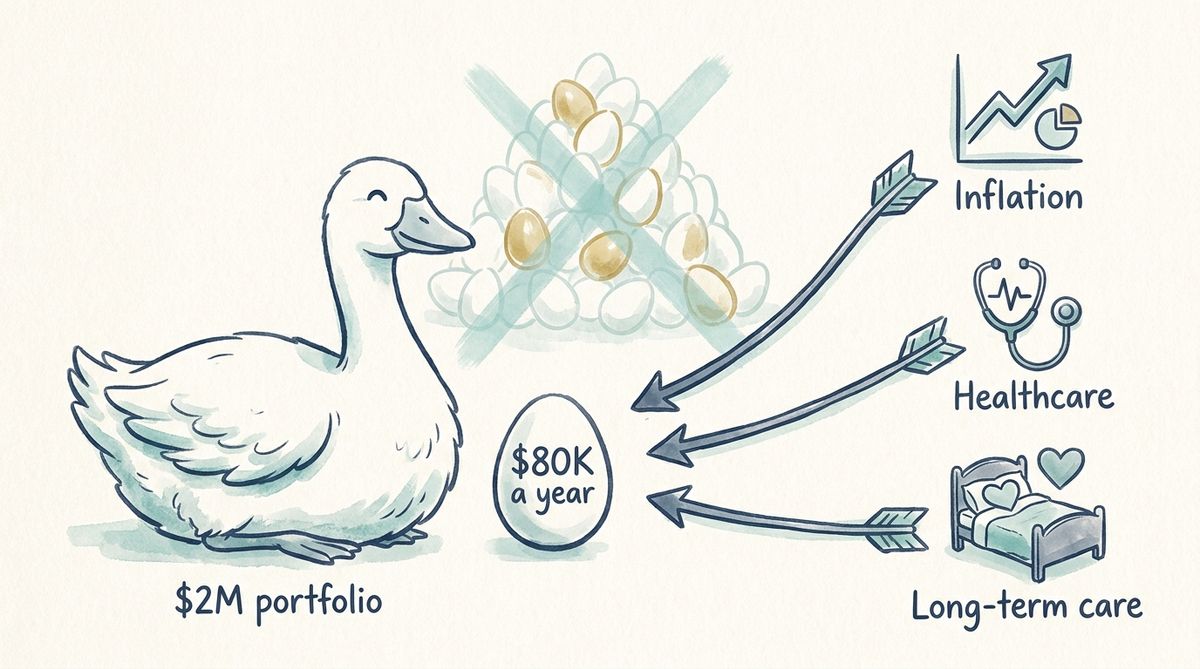
- $2 million is a goose, not a pile of golden eggs. At a 4% withdrawal rate, every $25,000 you give away permanently removes about $1,000 a year of income.
- Once family knows the number, every "no" gets measured against it, and your own plan starts bending around a "family reserve" that blocks smart moves like Roth conversions.
- Visible wealth attracts fraudsters and lawsuits, and confident, well-educated investors are the most likely fraud victims.
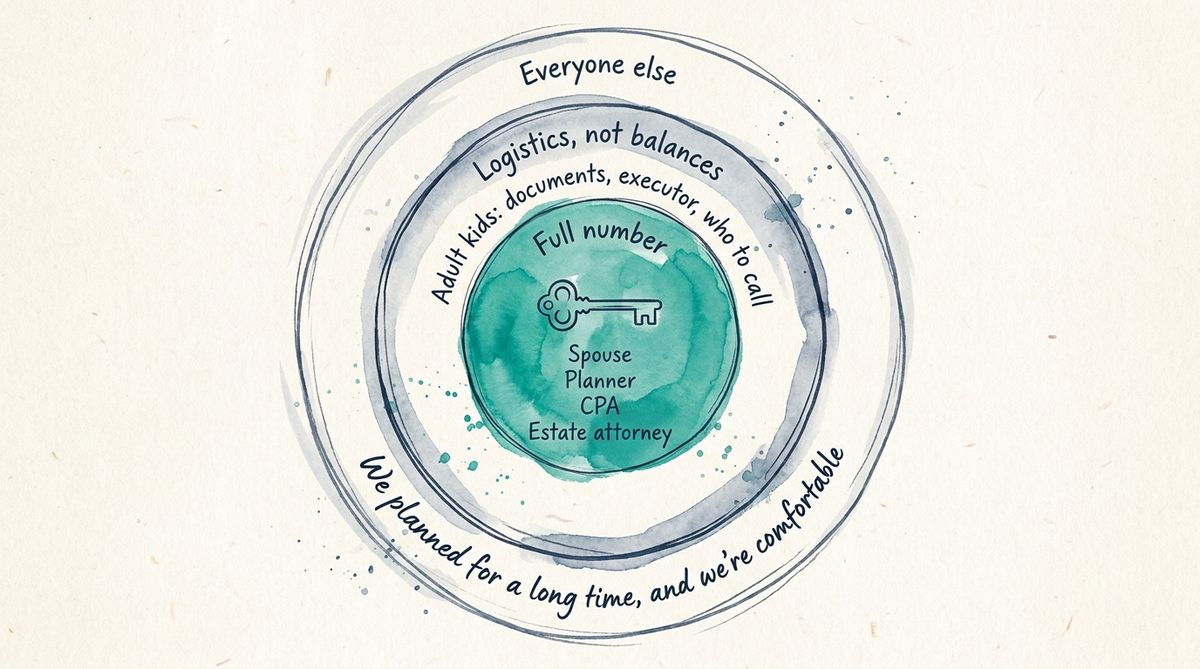
- Aim for privacy without lies: use scripts, a written family giving policy, and a short list of people who get the full number.
Bottom line: share the policy, not the number.
You want to tell somebody. Of course you do. At dinner your sister asks if you two will "be okay" now that you've stopped working. Your adult son wants to know how on earth you managed to retire at 62. An honest answer would put everyone at ease, and you'd finally get to enjoy something very few people ever pull off.
Don't give it.
I know. This is a nice problem to have. Most people would trade places with you in a heartbeat, and I feel a little funny writing a whole article about what not to say once you've got two million bucks. But I've watched this go sideways for enough good people that I think it's worth a real conversation.
My friend Gail in Dallas has a rule she got from her grandmother: at the table you can talk about food, football and family, but never money. I used to think that was a bit old-fashioned. The longer I spend around retirement planning, the more I think her grandmother was onto something.
And it's not because your family is greedy. Most families aren't. The problem is how the whole thing works. Once a number gets said out loud, it changes how people see you, how you see yourself and how you handle the money. Financial privacy isn't distrust. It's risk management for the retirement income engine that has to pay for the next 30 years of your life. When you retire with $2 million, sharing that figure is one of the most expensive mistakes you can make, because the costs show up slowly and never appear on a statement.
The Perception Gap: Golden Eggs vs. the Working Goose
Let's start with how rare you are. The Federal Reserve's 2025 Survey of Consumer Finances, released October 9, 2026, puts the median net worth for households aged 65 to 74 at about $431,900. You've got nearly five times that, so you're wealthier than roughly four out of five people your age. And that median includes home equity. If your $2 million is just the portfolio, you're even rarer.
To the people around you, that sounds like a vault. Dinner tabs get covered. Down payments appear out of nowhere. A $15,000 wedding contribution looks like pocket change.
Your balance sheet sees it differently, and Aesop figured this one out a long time ago. A $2 million portfolio isn't a pile of golden eggs. It's the goose, and its whole job is to lay one modest egg a year for three decades. Under Bill Bengen's classic 4% rule, $2 million produces about $80,000 a year before taxes, or $6,667 a month. (Bengen himself now makes the case for a 4.7% safe withdrawal rate, and Morningstar's latest research says 3.9%. Four percent is a sensible middle.)
That $80,000 has to cover everything:
- Inflation. At 3%, today's $80,000 lifestyle costs about $189,000 by year 30 of retirement.
- Healthcare. Fidelity estimates a 65-year-old retiring in 2026 will spend $185,500 on healthcare in retirement, and a couple roughly twice that. Medicare's IRMAA surcharges kick in above $218,000 of joint income, based on your tax return from two years earlier. They work like cliffs: go one dollar over a threshold and you pay that tier's full surcharge.
- Long-term care. A private nursing-home room runs a national median of $129,575 a year. Three years of that would eat about 19% of your portfolio.
The math to tape to the fridge
At a 4% withdrawal rate, every $25,000 you hand out permanently removes about $1,000 a year of income. A $150,000 rescue costs you $6,000 a year, for life. Left invested at 6% for 20 years, that same $150,000 would have grown to about $481,000.
And that's if the money comes from cash. Say you and your spouse are over 65 and already pulling $80,000 a year from your IRAs. To hand over $150,000 from a traditional IRA, you'd have to withdraw about $188,000 to cover 2026 federal taxes. That extra income also pushes you over the first IRMAA threshold, so your Medicare premiums go up two years later. Ouch.
Then there's timing. As Michael Kitces puts it, sequence-of-returns risk "is not a story of the bad first year in the markets; it's the story of the bad decade." Here's your Year 2 withdrawal ($82,400 after a 3% inflation raise) under three different Year 1 scenarios:
| Year 1 scenario | Portfolio entering Year 2 | Year 2 withdrawal rate |
|---|---|---|
| Market up 6% | $2.04M | 4.05% |
| Market down 20% | $1.54M | 5.4% |
| Market down 20%, plus a $150K family rescue | $1.42M | 5.8% |
Look at that third row. Getting back to $2 million takes a 41% gain, and you're still withdrawing the whole time. The goose can survive a bad market. Surviving a bad market and a bailout in the same year is a lot harder. Your own portfolio, spending and tax picture will produce different numbers than this table, and you can run them for your own situation at ReadyAimRetire.com.
Your family can't see any of this. All they can see is the number.
The Relational Tax: The Unchosen Denominator in Family Money Dynamics
There's a classic behavioral economics experiment called the "ultimatum game." One player proposes how to split a pot of money, and the other accepts or rejects the offer. If they reject it, both walk away with nothing. People reject anyway when a split feels stingy compared with the size of the pot. A meta-analysis of 37 papers found that roughly one offer in six gets turned down. People will give up free money to make a point about fairness.
Once your family knows the number, they're playing that game with a denominator you never chose. Every decision you make gets measured against $2 million.
You pass on co-signing a car loan. You give $2,000 as a wedding gift. You say no to a $15,000 request. Each of those is perfectly reasonable on its own, but each one gets divided by two million: They have two million dollars, and they wouldn't cover fifteen thousand? Nobody's the bad guy here. Your niece isn't greedy. She's just doing the math you handed her.
The bigger loss is what happens to generosity itself. When you're "comfortable," a gift lands as a gift. When you're "the multimillionaires," the exact same gift reads as an overdue dividend: something owed, not offered. And saying yes carries its own risk. Bankrate's 2024 survey asked people who had lent money or covered a shared expense, expecting to be paid back, how it turned out. 42% lost money, and 24% said the relationship was damaged. So disclosure doesn't just multiply the asks. It also shrinks the good feeling you get from every yes.
And the pressure isn't only coming from other people.
Internal Plan Distortion: The Subconscious Reserve (and Your Roth Conversion Strategy)
Here's the sneaky part. Disclosure bends your plan before anyone asks you for a dime.
Meet a composite couple I'll call Mark and Diane. They're both 62, and they retire with $1.5 million in IRAs and 401(k)s, $250,000 in a taxable account and $250,000 in cash. Their family knows the total. So without ever saying it out loud, they start treating that cash as a safety net for everybody else: his sister's divorce that everyone can see coming, her mom's assisted living (a national median of $74,400 a year), the grandkids' tuition.
That cash earns roughly 3.5% to 4% in a money market fund. That's about what inflation is taking, and less than that after taxes. But the real cost is the tax plan it blocks.
The years between retirement and required minimum distributions (RMDs) are the best Roth conversion window most people will ever get. In 2026, a married couple who are both 65 or older can have about $148,000 of income taxed at no more than 12%. You get there by adding the $35,500 standard deduction, $12,000 of temporary senior deductions (available through 2028) and a 12% bracket that runs up to $100,800 of taxable income. Before 65, the number is about $133,000. Mark and Diane were born in 1964, so their RMDs don't start until 75. That gives them 13 years of this space. And bracket space you don't use is gone for good. It doesn't roll over like cell phone minutes.
The obvious place to pay the conversion taxes from is the exact cash Mark and Diane are guarding. Since they won't touch it, their Roth conversion strategy never gets off the ground. At 75, RMDs stacked on top of Social Security push them into higher brackets. Then comes the widow's penalty. When one spouse dies, the survivor soon files as single. The standard deduction drops from $35,500 to $18,150, and the IRMAA threshold is cut in half, from $218,000 to $109,000. So the "family reserve" ends up raising taxes on the family's own surviving parent, which is pretty much the opposite of what Mark and Diane wanted.
Married, filing jointly
- Standard deduction $35,500
- IRMAA threshold $218,000
Surviving spouse, filing single
- Standard deduction $18,150
- IRMAA threshold $109,000
The Uninvited Audience
Then there's the day-to-day performance. Once relatives know your net worth, your spending turns into evidence. The kitchen remodel, the Viking cruise photos, the new SUV: every one of them gets read as proof that there's plenty to go around. It's like starring in a reality show you never auditioned for.
Full disclosure (pun intended): I've worked remotely from dozens of countries and posted more than my share of sunset photos, so I'm not pointing fingers here. But visible wealth really does change how the people around it behave. Economists who studied Canadian lottery winners found that the bigger the prize, the more the winners' neighbors borrowed and the more often they filed for bankruptcy.
A widely shared Reddit post from April 2026 showed the family version. A 51-year-old engineer, semi-retired with about $4 million, wrote that once relatives saw his vacation photos on Facebook, they "came knocking for money." You start editing your life for an audience you never invited, which is the exact opposite of what financial independence was supposed to buy you.
The Trap of Endless Horizons: "One More Year" Syndrome
Here's the imbalance that keeps people working:
You can put a ceiling on your own retirement needs. You can never put a ceiling on what everyone around you might eventually need.
When your plan quietly includes a sibling's emergency fund, a parent's care and your kids' down payments, the finish line keeps moving. Northwestern Mutual's 2026 study found Americans think they need $1.46 million to retire comfortably. Respondents with more than $1 million in investable assets put it at $2.67 million. "Enough" has a funny way of rising to meet whatever you've got.
So you work one more year to build the buffer. The math doesn't do you any favors. Say you add a $250,000 family reserve to a $2 million target, earn 5% a year and save $30,000 a year. Hitting the new target takes about two more years of work. And the calendar often isn't yours to control anyway. EBRI's 2026 Retirement Confidence Survey found 46% of retirees stopped working earlier than they planned, often because of health problems or changes at work. Workers expect to retire at 65. The median retiree actually stops at 62.
The years from roughly 55 to 65 are a golden decade of health and freedom. My man David retired at 58 and calls it his "knees still work" decade. Very few people would knowingly spend those years building a cushion for rescues that may never be needed. Disclosure makes that trade a lot more likely.
And family isn't the only audience watching.
External Exposure: Elder Fraud, Lawsuits and the Target on Visible Capital
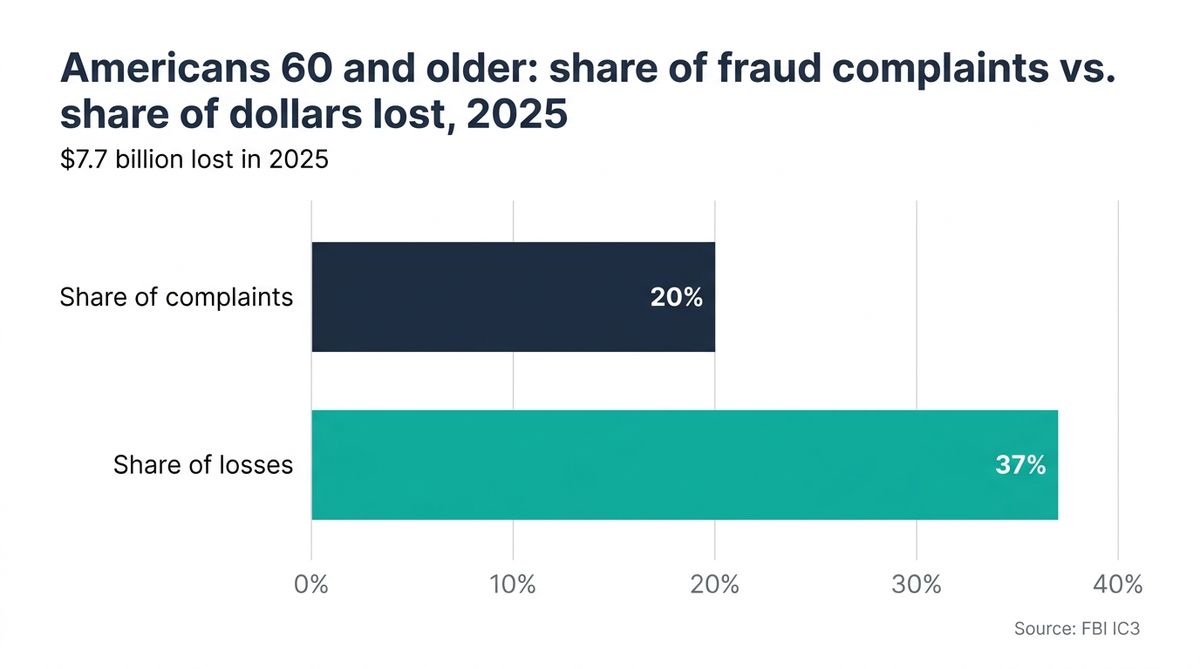
The FBI's Internet Crime Complaint Center reported that Americans 60 and older lost $7.7 billion to online fraud and cybercrime in 2025, up 59% in a single year. They filed 20% of the complaints but took 37% of the losses. Investment fraud was the biggest category by dollars, at about $3.5 billion. And that's only what people reported. The FTC estimates the true 2024 cost of fraud against older adults at somewhere between $10.1 billion and $81.5 billion.
The victims probably aren't who you'd picture. Research from the FINRA Investor Education Foundation and AARP found investment-fraud victims were more likely to be better educated, higher-income and more financially literate than non-victims. They were also more likely to trust their own judgment. As AARP fraud researcher Doug Shadel put it: "We assumed that the people who were defrauded were less financially literate… It's not the case at all."
So the confident, self-reliant investor who built $2 million? That's exactly who fraudsters are looking for. Every public signal helps them find you: the country club, the retirement-party post, the neighborhood chatter. Even your vacation videos become raw material. The FTC warns that a short clip posted online is enough to clone a grandchild's voice for a fake "emergency" call. That one gives me chills.
Visible wealth draws lawsuits, too. Chubb's 2024 Wealth Report found 92% of affluent households worry about a liability lawsuit, yet only 28% carry enough excess liability insurance. In Chubb's 2025 survey, 81% had none at all. If a guest slips by the pool at the "two-million-dollar neighbors'" house, a typical homeowner's policy covers $100,000 to $500,000 of liability. Anything above that can come out of your portfolio.
Five low-cost steps for elder fraud prevention and retirement asset protection
- Buy an umbrella policy. It runs roughly $150 to $400 a year per $1 million of coverage.
- Name a trusted contact on every brokerage and retirement account.
- Freeze your credit at all three bureaus and get an IRS Identity Protection PIN.
- Agree on a family code word for any urgent call asking for money.
- Ask data broker sites to remove your information. If you're in California, the state's DROP platform lets you reach roughly 600 registered brokers with one request.
The most common leak, though, starts at home.
Spousal Alignment: The United Front on Family Financial Boundaries
Back to that dinner table. Your sister asks whether you two will be okay. Your spouse wants to reassure her and says, "Oh, we're fine. We've got about two million."
Now picture the next 18 months: a $15,000 wedding request, then a down-payment "loan," then your brother-in-law's business idea. Both of you have to defend every no, even though only one of you shared the number. Kansas State researcher Sonya Britt studied more than 4,500 couples and found that "arguments about money is by far the top predictor of divorce."
There's a longer-term risk, too. UBS's 2018 study of affluent investors found that 56% of married women leave long-term financial decisions to their husbands, and 59% of widows and divorcees regretted not being more involved. (If that sounds familiar, here's what happens when one spouse handles all the finances.) A surviving spouse who never helped set the family's financial boundaries inherits the portfolio, the pressure and the widow's penalty all at once. That's a lot to land on someone who's grieving.
The fix: move from "discretion by default" to "disclosure only as a joint, deliberate decision." Sit down together and agree on what you'll share, who you'll share it with and how family giving will work. Then neither of you has to wing it at the dinner table.
What to Say in Real Life: Scripts for Protecting Your Financial Privacy
Quick word of caution first. Remember that $4 million Redditor? He'd told his wife to "pretend that we are dead broke." Then their son mentioned the retirement to his grandparents. Relatives, he wrote, "have been calling me livid" because the couple had pretended to be broke for years. The goal is privacy without lies. Say less, but never make stuff up.
When someone asks directly
"We planned for a long time, and we're comfortable. The boring answer is that we just saved for thirty years."
The humor pivot
Say this
"Enough to retire, not enough to stop clipping coupons. Did you try the stuffing?"
Keep it light and warm, then change the subject. You close the door without slamming it.
The professional scapegoat
Psychologist and CFP® Brad Klontz warns that saying no and then caving creates "intermittent reinforcement." It's the same pull that keeps people feeding slot machines in Vegas. His fix is to appeal to a higher authority:
Say this
"Sorry, I want to help, but my financial planner says it just isn't possible."
Or the policy version:
"We have a rule with our planner: no lending or gifting outside the plan we set each January. I can't make exceptions on the spot."
Let your planner be the bad guy. That's part of what you pay them for.
When the cat's already out of the bag
Reframe the number, truthfully. For most 401(k) savers, the bulk of $2 million sits in tax-deferred accounts built to pay out over decades. If that's you:
Say this
"That number sounds bigger than it is. Most of it's in retirement accounts where every dollar we take out gets taxed, and it's set up to pay us a fixed monthly paycheck for the next thirty years. It's not a checking account."
If that's not you, don't say it.
Disclose the policy, not the number
Better than any script is a written family giving policy with three parts:
- a fixed annual giving budget built into your spending plan;
- 529 contributions for the grandkids;
- tuition or medical bills paid directly to the school or provider. Direct payments like these don't count against the $19,000-per-person annual gift exclusion.
Then add one rule: only give what you'd be fine never seeing again.
Disclose the number
- Every "no" Measured against $2M
- Gifts Read as owed
- Who defends it You, every time
Disclose the policy
- Giving Fixed annual budget
- Gifts Feel like gifts
- Who defends it The plan and your planner
The list of people who need the full number is short: your spouse, your planner, your CPA and your estate attorney. That's it. Your adult kids need logistics, not balances. They need to know where the documents are, who the executor is and who to call. (If you're wondering how to start that conversation, talking about passing on wealth is the hardest part.) A revocable living trust, a staple of estate planning, keeps your estate out of public probate records, though it won't protect it from creditors.
The Peace Dividend of Stealth Wealth
The point of $2 million was never to impress people at dinner parties. It was freedom: waking up without an alarm, saying yes to the trips and no to the obligations, and finally not worrying about money.
That last one is harder than it sounds. Allianz's 2026 study found 67% of Americans worry more about running out of money than about death. A BlackRock and EBRI study found that retirees who started with $500,000 or more still held 83% of their savings after 18 years. Retirement anxiety already keeps a lot of people from enjoying what they built. Disclosure just feeds it.
Stealth wealth pays a dividend you'll never see on a statement: fewer awkward asks, cleaner relationships, a tax plan driven by math instead of fear, and gifts that feel like gifts again. Think Clark Kent. The happiest retirees are often the least identifiable ones: wealthy on paper, completely unremarkable at the barbecue.
🎯 Your Next Steps Once You Retire With $2 Million
- Align with your spouse: Agree on a disclosure rule before the next family dinner.
- Write it down: Put your family giving policy on paper, with a fixed annual budget.
- Protect the goose: Price an umbrella policy and freeze your credit.
- Use the window: Map your Roth conversion window with your planner before another year of bracket space disappears.
Start by modeling your retirement at ReadyAimRetire, so the giving budget in step two comes from your own numbers instead of a guess.
The quiet discipline that built your $2 million over 30 years is the same discipline that'll protect it for the next 30. You never needed an audience to build it. You don't need one now.
Thanks for reading if you've made it this far. Peace!
Run Your Own Numbers at ReadyAimRetire
Disclaimer: This article is for educational purposes only and does not constitute legal, tax or financial advice. Figures are illustrative and based on 2026 rules and the sources cited. For personalized guidance, consult a qualified financial planner, CPA or estate attorney.